
Executive Summary: The China Smart Eyewear Sourcing Landscape
The global augmented reality (AR) and smart eyewear sector is undergoing a profound paradigm shift. Transitioning from heavy, tethered industrial headsets to sleek, prescription-ready consumer smart glasses, the market demands unprecedented convergence between optical engineering, high-density power architecture, real-time wireless protocols, and multimodal artificial intelligence. China—and specifically the Shenzhen high-tech industrial cluster in Guangdong—has solidified its role as the world's primary engine for smart glasses R&D, tooling precision, and scalable OEM/ODM manufacturing.
For international buyers, brands, Amazon top-sellers, and telecom distributors, selecting the right manufacturing partner in China requires going beyond mere assembly pricing. It demands an in-depth audit of optical waveguide sourcing, surface-mount technology (SMT) micro-soldering standards, electromagnetic compatibility (EMC) engineering, and long-term firmware firmware over-the-air (OTA) update support. As an established leader in smart wearable design since 2014, Awia Electronic Commerce Co., Ltd. provides this comprehensive whitepaper to dissect the technical dynamics, procurement frameworks, and market evolution driving the smart glasses ecosystem.
2025–2030 Technical Evolution Trends in Smart & AR Glasses
Understanding the hardware roadmap is crucial for brand managers seeking to protect their product catalogs against rapid obsolescence. Over the next five-year cycle, four key engineering domains will dictate product competitiveness in the consumer and enterprise AR space:
1. Optical Display Engines: MicroLED & Waveguides
The industry is transitioning away from bulkier Free-form and Birdbath optical modules toward diffractive surface relief waveguides (SRW) powered by MicroLED light engines. MicroLED provides luminance levels exceeding 100,000 nits, ensuring outdoor legibility under direct sunlight while consuming up to 40% less power than legacy Micro-OLED configurations. Chinese manufacturing ecosystems are rapidly scaling volume production of optical engines under 0.5cc in volume, enabling AR glasses to visually mirror standard high-end fashion eyewear.
2. Edge AI & Multimodal On-Device Intelligence
Modern smart eyewear is no longer just a passive display or audio receiver; it serves as the primary hands-free interface for generative AI models. Modern platforms incorporate low-latency, low-power Bluetooth 5.3/5.4 Chipsets linked with edge-processed noise cancellation (ENC) dual-microphone arrays. This architecture enables continuous voice-triggered access to multimodal Large Language Models (LLMs) like ChatGPT, Claude, and proprietary enterprise engines—delivering instantaneous real-time translation, scene recognition, and contextual voice navigation directly into the user's field of audio and vision.
3. Acoustic Beamforming & Open-Ear Audio Ergonomics
To eliminate the isolation of traditional in-ear headphones while maintaining private listening, premier manufacturers employ directional acoustic beamforming speakers embedded directly into the temple stems. By pairing dual micro-drivers with phase-reverse sound-leakage cancellation chambers, sound waves are directed precisely into the user's ear canal, reducing external sound spill by over 85% even at high volume levels.
4. High-Density Power Management & Companion Charging Cases
Battery capacity remains the fundamental bottleneck in wearable micro-electronics. Chinese factories have pioneered dual-cell lithium polymer architectures integrated symmetrically into the left and right temple arms to equalize nose-bridge pressure. Furthermore, the introduction of magnetic micro-contact charging cases equipped with integrated 1400mAh to 3600mAh power banks extends field operation to over 30 hours, completely mitigating battery anxiety for end-users on the go.
Technical Architecture Matrix: Platform Comparison
When selecting a core platform for private-label customization or bulk wholesale, hardware teams must evaluate specs against target consumer use-cases:
| Platform Category | Optical / Camera Spec | Audio & Connectivity | Battery & Case Reserve | Target B2B Market |
|---|---|---|---|---|
| Smart Audio & AI Voice | N/A (Standard UV400 / Prescription) | Dual Speaker Beamforming, BT 5.3, ENC | 110mAh x 2 (6h Playback) | Daily Wear, Fashion Retail, Corporate Gifts |
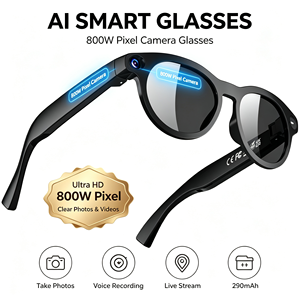
| HD Camera & Live Video | 8MP / 1080P 30fps Anti-Shake Lens | WiFi High-Speed Transfer, Bluetooth Call | 180mAh + 1400mAh Charging Case | Vlogging, Field Inspection, Social Content |
| AI Real-Time Translation | Optional Micro-Camera for Image OCR | Dual-Mic Array, Multimodal LLM Cloud API | 140mAh (5h Continuous Translation) | Cross-Border Business, Tourism, MICE |
| Full Optical AR Waveguide | Monocular / Binocular Waveguide MicroLED | Spatial Audio, BLE 5.4, Motion IMU | 220mAh + External Pocket Pack | Industrial Maintenance, Logistics, Navigation |
Strategic Procurement & Supply Chain Trends for Global Exporters
Procuring smart glasses from China has matured significantly beyond standard off-the-shelf trading. Sophisticated buyers now structure their vendor relationships around three primary procurement models:
1. Rapid Sample Validation & Low-MOQ Stock Prototyping
To reduce inventory risk and test product-market fit on e-commerce platforms such as Amazon, TikTok Shop, or regional retail chains, top-tier suppliers like Awia allow sample orders starting from 1 piece. This enables hardware buyers to rigorously evaluate physical build quality, bluetooth pairing latency, companion app integration, and acoustic clarity prior to committing capital to mass production runs.
2. OEM Private-Label Branding & Package Localisation
For established brands seeking turnkey expansion into smart wearables, OEM services encompass far more than silk-screening logos onto temple arms. Mid-tier production runs (typically starting at 200–500 units per SKU) include custom firmware boot screen logo injection, dedicated Bluetooth pairing naming (e.g., "YourBrand-Audio-Glasses"), localized user manuals in 10+ languages, and custom-designed retail packaging ready for immediate retail shelf placement.
3. ODM Private Tooling & Exclusive Regional Rights
Enterprise clients and regional market leaders seeking true product differentiation utilize full ODM (Original Design Manufacturing) services. By investing in dedicated injection mold tooling, unique industrial frame aesthetics, customized PCB layout design, and tailored iOS/Android mobile apps, clients secure long-term intellectual property protection and exclusive territorial distribution rights for their custom eyewear hardware.
Enterprise Core Competencies: Why Partner with Awia
Located in the heart of Shenzhen's electronics ecosystem, Awia Electronic Commerce Co., Ltd. (awiatech.com) operates as a verified engineering and manufacturing power for advanced AI smart glasses, smartwatches, and health-tracking wearables since 2014.
In-House Tooling & Engineering
We operate dedicated plastic injection mold shops and optical alignment labs spanning over 2,000m², maintaining total control over hardware tolerances, thermal dissipation, and structural integrity.
Full Export Certification
All product lines ship fully certified with CE, FCC, RoHS test reports and formal EU Declarations of Conformity (DoC). Lithium batteries are covered by MSDS and UN38.3 air/sea transport documentation.
Rigorous EVT / DVT Quality Gateways
Every platform undergoes strict Engineering Validation Test (EVT) and Design Validation Test (DVT) cycles—including 50,000-cycle temple hinge flex testing, IPX5 water-spray chambers, and environmental heat-cycle testing.
Global Logistics & Dropshipping Ready
We maintain localized ready-to-ship inventory reserves in Shenzhen, offering neutral unbranded packaging and API-driven single-parcel fulfillment direct to end consumers worldwide.